🗽 Statues & Monuments|紀念雕塑
Related: 8964 Museum | Hong Kong Alliance | 🎵 Glory to Hong Kong|願榮光歸香港 | 📕 Book Censorship under the NSL
For a quarter-century Hong Kong's campuses and public spaces held some of the only monuments on Chinese soil to the victims of the 1989 Tiananmen crackdown, joined after 2019 by statues born of the protest movement. Within an 18-month sweep following the 2020 National Security Law, almost all were erased — dismantled in pre-dawn operations, seized as police evidence, toppled by unknown hands, or driven into exile as replicas abroad.
The erasure ran parallel to the shuttering of newsrooms and unions and the freezing of the Hong Kong Alliance that had organised the annual June 4th vigil — part of the same "great extinction" of the city's civil society. This page tracks the monuments and their afterlives.
The Pillar of Shame (國殤之柱)
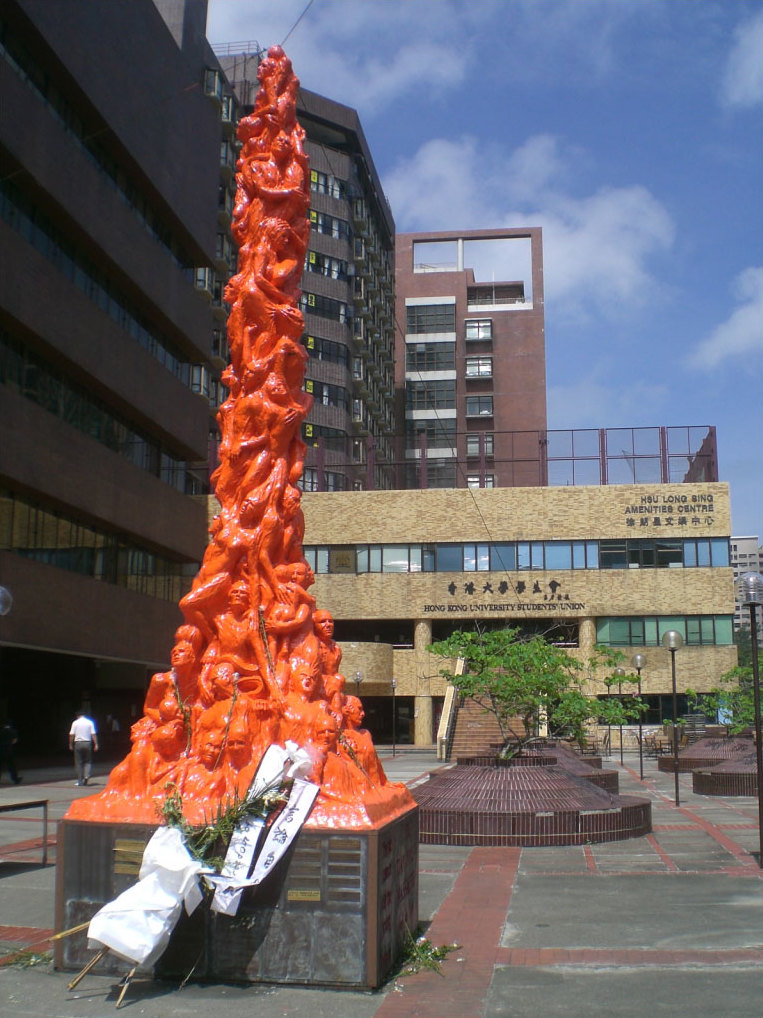 The Pillar of Shame at the University of Hong Kong, painted orange for a June 4th anniversary. Photo: PSH851, CC BY 3.0, via Wikimedia Commons.

The Pillar of Shame (國殤之柱) is an 8-metre, two-tonne copper sculpture by the Danish artist Jens Galschiøt — a writhing tower of some 50 torn and anguished bodies memorialising those killed in Beijing on 4 June 1989. Installed at the University of Hong Kong in 1997, the handover year, it stood on campus for 24 years, washed each spring by students before the Victoria Park vigil; it was the most prominent Tiananmen memorial in the city.
After the Hong Kong Alliance disbanded in September 2021, HKU ordered the statue removed on legal-risk grounds. In the early hours of 22–23 December 2021 it was crated up behind plastic barriers and hauled into storage at the university's Kadoorie Centre; Galschiøt called the removal a "crime against democracy" (Al Jazeera · NBC News). In May 2023, national-security police obtained a warrant and seized the sculpture as an "exhibit" in the Alliance's incitement-to-subversion case (The Art Newspaper · RFA). Galschiøt — who says he owns the work, having only lent it to the Alliance in 1997 — has campaigned for its return, launching an augmented-reality project to re-project it and observing that the seizure had only made the artwork "bigger" (Artnet).
Days after the Alliance's leaders were convicted (see 8964 Museum), prosecutors asked the court to confiscate the Pillar as an exhibit in the case — raising the prospect of its destruction. On 1 September 2026 Galschiøt wrote to the Hong Kong court demanding it back: "I claim the sculpture … I do not consent to its confiscation, destruction, disposal, or transfer to any other person or institution," saying he would send professional art handlers to bring it to Denmark rather than travel to Hong Kong himself (HKFP). When the leaders were jailed on 11 September 2026 — Chow Hang-tung 7 years 3 months, Lee Cheuk-yan 7 years, Albert Ho 5 years 2 months — the court had still not ruled on the sculpture's fate; it remains locked in a steel container at HKU's Kadoorie Centre, its return or destruction undecided. Replicas of the Pillar now stand outside the Danish Parliament and in Berlin, Mexico, Brazil and Rome — the monument multiplying abroad as the original stays impounded.
The Goddess of Democracy (民主女神像)
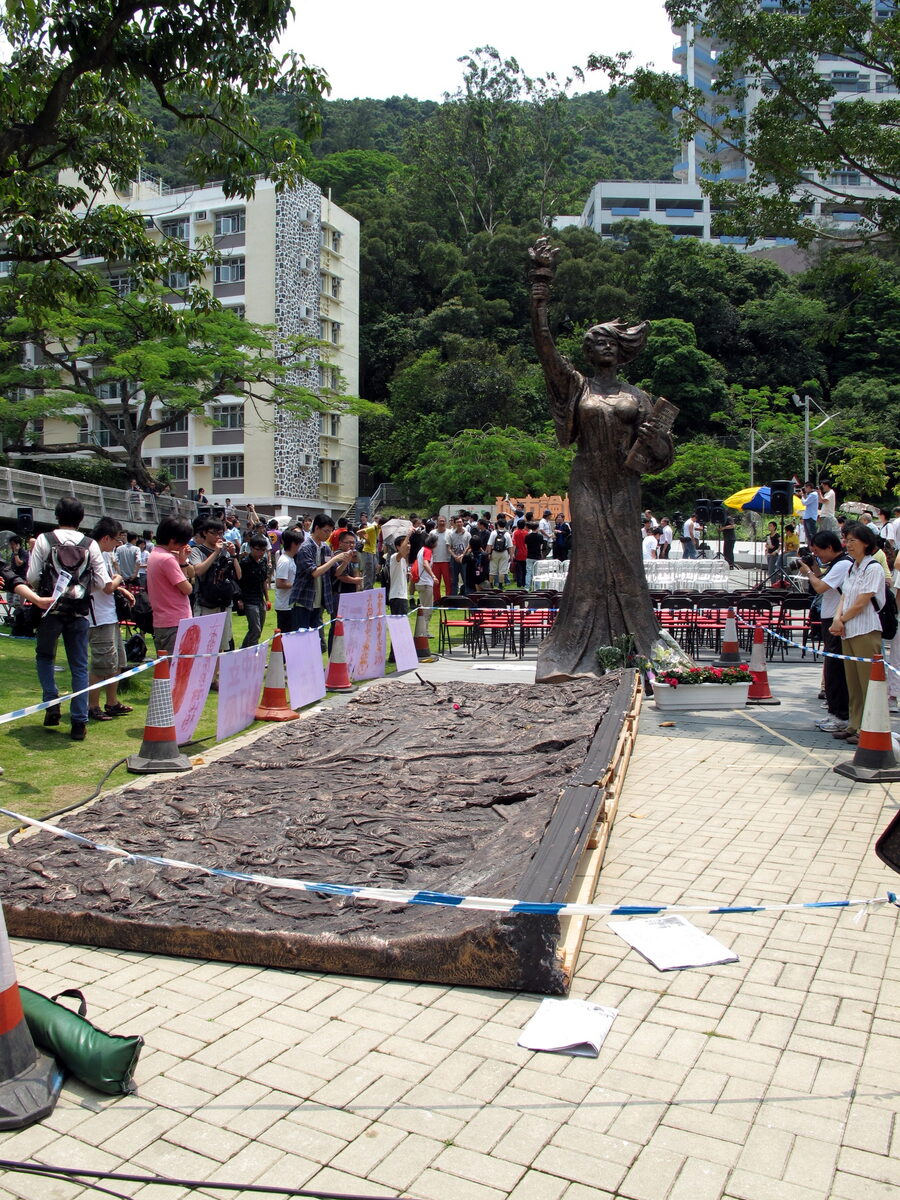 The Goddess of Democracy at the Chinese University of Hong Kong (2010). Photo: WiNG, CC BY-SA 3.0, via Wikimedia Commons.

The Goddess of Democracy (民主女神像) at the Chinese University of Hong Kong was a 6.4-metre bronze by the exiled sculptor Chen Weiming (陳維明) — a replica of the papier-mâché figure that Beijing art students raised in Tiananmen Square in 1989 before the People's Liberation Army destroyed it. A student union installed it at CUHK in 2010.
In the pre-dawn hours of Christmas Eve, 24 December 2021 — a day after the Pillar came down — CUHK removed the Goddess, calling it "unauthorised" and saying it had never approved the students' 2010 request (HKFP · SCMP · CNN).
Lingnan University's June 4th relief
Hours later the same morning, Lingnan University took down its own Tiananmen memorials — a June 4th relief sculpture, also by Chen Weiming, and a related wall mural — citing safety and legal concerns (Al Jazeera · PBS NewsHour / AP · RFA).
Lady Liberty (香港民主女神, 2019)
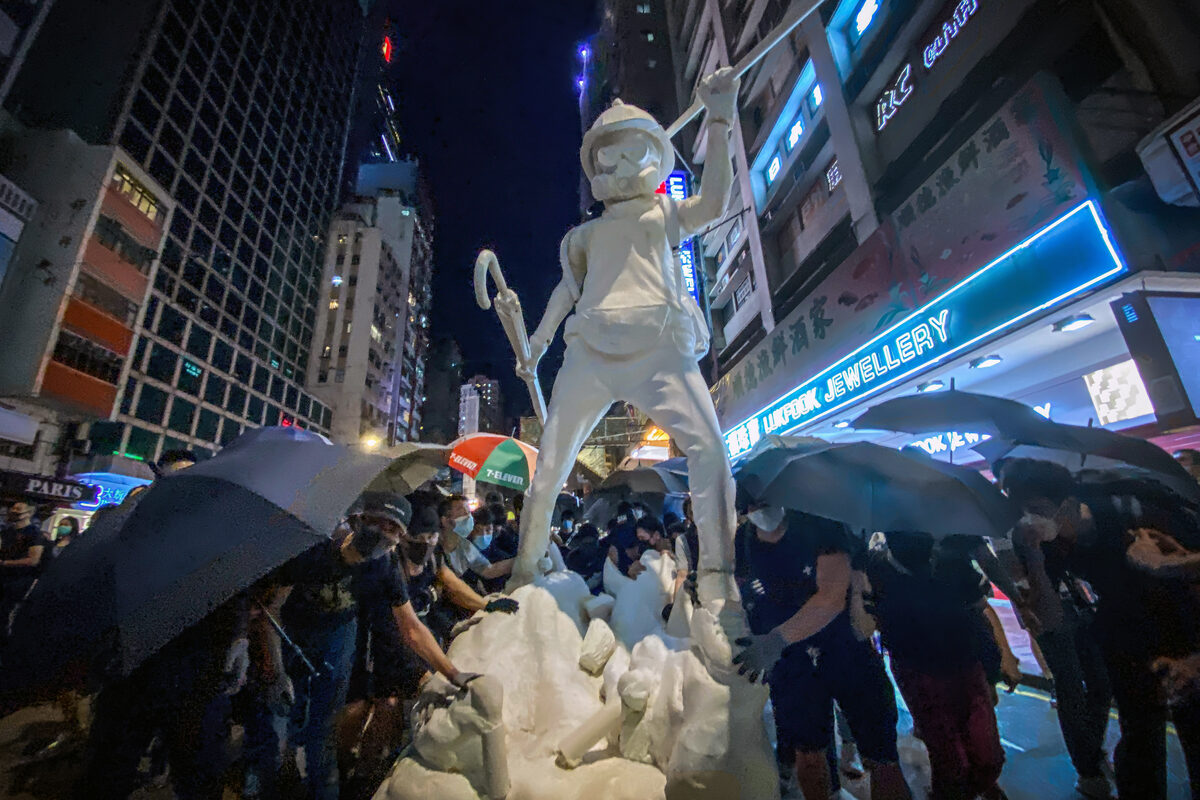 Lady Liberty Hong Kong among protesters (Mong Kok, 4 October 2019), before it was carried up Lion Rock. Photo: Studio Incendo, CC BY 2.0, via Wikimedia Commons.
.jpg)
Not every toppled statue commemorated 1989. Lady Liberty Hong Kong (香港民主女神) was a roughly 4-metre figure of a 2019 protester — gas mask, goggles and helmet, an umbrella in one hand and a black flag in the other, bearing the slogan "光復香港,時代革命" ("Liberate Hong Kong, revolution of our times"). Like the anthem Glory to Hong Kong, it was crowd-designed on the LIHKG forum and crowdfunded, then built in August 2019.
Volunteers hauled the statue up Lion Rock overnight on 13 October 2019, declaring the summit its "final resting place" (France 24 · HKFP). Within a day it was toppled, splashed with red paint by unknown assailants and then vanished — only the flagpole and fixings left on the peak (HKFP). Replicas were later raised abroad, in Frankfurt and elsewhere.
Preserved as a file. The statue was itself a crowd project: a public LIHKG vote chose the design and a six-hour crowdfunder raised HK$203,933 — roughly HK$50,000 for the statue, the rest to the 612 Humanitarian Relief Fund — with teams of about 10 designers and 30 printers assembling it. So when the physical figure was destroyed, its makers' answer was to place it beyond destruction: they released the design as a 3D-printable file so it could be re-printed anywhere. The files are still public — the team's original Thingiverse upload (eight STL parts plus a 26 MB whole-figure model, CC BY-NC), mirrored at 3DFinder.
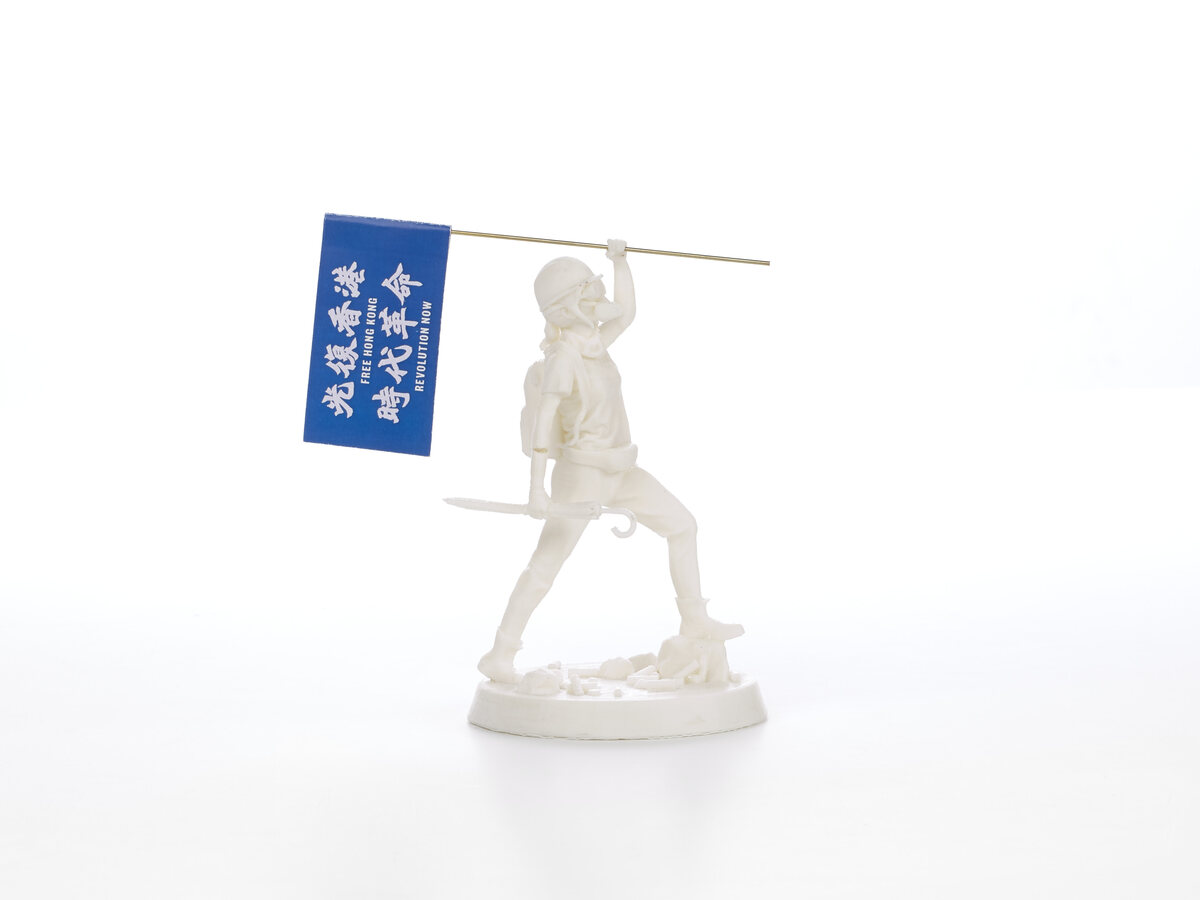 "Lady Liberty HK holding flag" — an anonymous 2019 Wellington-made 3D print, in the national collection of the Museum of New Zealand Te Papa Tongarewa (object 1887451). © LadyLibertyHK, CC BY-NC 4.0.
That file outlived the statue. One authentic print of it — made anonymously in Wellington in 2019 and photographed at New Zealand landmarks in solidarity — was acquired by the Museum of New Zealand Te Papa Tongarewa, entering a national collection under the campaign's own credit (© LadyLibertyHK). The four-metre original was toppled and lost within a day; this ~17 cm figure, printed from the shared file an ocean away, is the version that still stands — a monument that could be smashed but not erased.
A coordinated erasure
The December 2021 campus removals — the Pillar, the Goddess and the Lingnan relief — came within 72 hours of one another, universities acting just before year's end amid the wider crackdown. Together with the banned vigil, the frozen Hong Kong Alliance and the shuttered 8964 Museum — which survives only online, from overseas — they mark the physical erasure of Tiananmen memory from Hong Kong's public space, even as the monuments reappear, in replica and in augmented reality, beyond the city's reach.
Backlinks