🕯️ Tiananmen Vigil|維園六四燭光集會
Related: Hong Kong Alliance | 8964 Museum | Chow Hang-tung | 🗽 Statues & Monuments
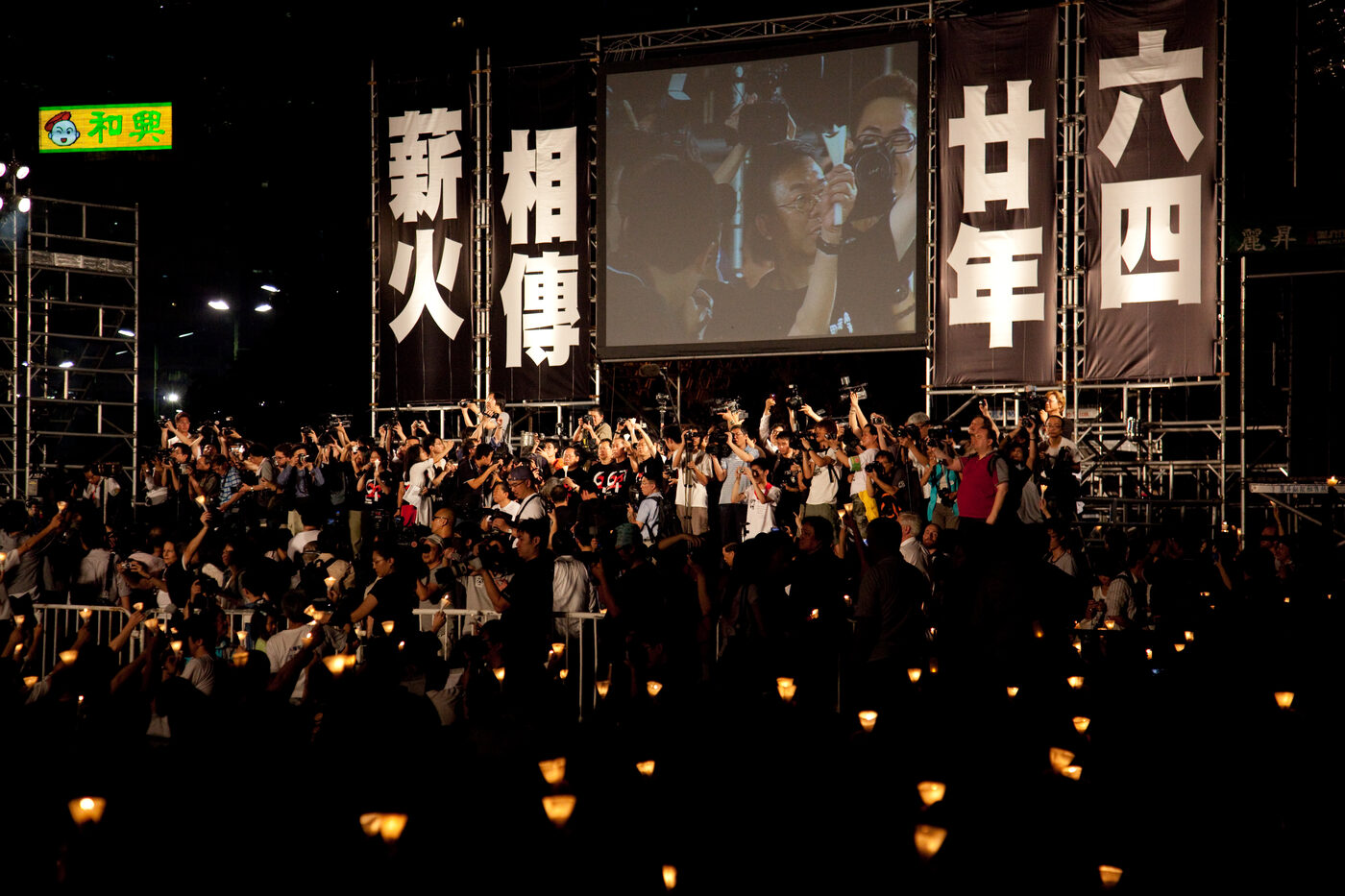 The 20th-anniversary vigil in Victoria Park, 4 June 2009, beneath banners reading 薪火相傳 ("passing the flame") and 六四廿年 ("June 4th, 20 years"). Photo: Kap Leung, CC BY 2.0, via Wikimedia Commons.

For thirty years, on the evening of 4 June, tens of thousands of Hongkongers filled the football pitches of Victoria Park with candles to mourn those killed in Beijing's 1989 Tiananmen crackdown. It was the largest annual commemoration of June 4th anywhere on Chinese soil — the one place under the Chinese flag where the massacre could be remembered in the open, year after year. Organised by the Hong Kong Alliance, the vigil was a fixture of the city's civic life from 1990 until 2019. Then, within two years, it was banned, criminalised, and erased — its site given over to a pro-Beijing carnival, its organisers imprisoned, and the very act of lighting a candle in the park turned into grounds for arrest.
This page preserves the vigil's history, and asks for your help completing its record.
Born from the massacre (1989–1990)
As the 1989 democracy movement swelled in Beijing, Hong Kong — then a British colony — watched with alarm and solidarity. On 21 May 1989 activists founded the Hong Kong Alliance in Support of Patriotic Democratic Movements of China (支聯會), and in the days around the 4 June crackdown as many as a million people marched in the city. The next year, on the first anniversary in 1990, the Alliance held the first formal candlelight vigil in Victoria Park; an estimated 150,000 attended. It would recur every year for three decades — a disciplined, peaceful ritual of songs, speeches, a minute's silence, and a field of flickering candles, closing with the vow to "never forget June 4th" (毋忘六四) and the demand to "vindicate the 1989 democracy movement."
Thirty years of candlelight
Through the 1990s and 2000s the vigil endured as the emotional centre of Hong Kong's democracy movement, its crowds swelling on landmark anniversaries. Two counts exist for most years and differ sharply — the Alliance counted people entering the park; police reported peak attendance — so this ledger sets them side by side rather than choosing between them, alongside each year's theme.
| Year | 週年 | 主題 · Theme | 大會 Organiser | 警方 Police |
|---|---|---|---|---|
| 1990 | 1st | 釋放民運人士、平反八九民運、結束一黨專政、建設民主中國 Release the activists; vindicate the 1989 movement; end one-party rule; build a democratic China | 150,000 | 80,000 |
| 1991 | 2nd | 釋放民運人士 Release the democracy activists | 100,000 | 60,000 |
| 1992 | 3rd | 釋放民運人士 Release the democracy activists | 80,000 | 28,000 |
| 1993 | 4th | 釋放民運人士 Release the democracy activists | 40,000 | 12,000 |
| 1994 | 5th | 我會來 "I will come" | 40,000 | 12,000 |
| 1995 | 6th | 平反六四 Vindicate June Fourth | 35,000 | 16,000 |
| 1996 | 7th | 跨越九七 Crossing 1997 | 45,000 | 16,000 |
| 1997 | 8th | 戰鬥到底 Fight to the end | 55,000 | — |
| 1998 | 9th | 平反六四 Vindicate June Fourth | 40,000 | 16,000 |
| 1999 | 10th | 毋忘六四十周年 邁向民主新世紀 Never forget June Fourth at ten years; toward a democratic new century | 70,000 | — |
| 2000 | 11th | 薪火相傳 Pass on the flame | 45,000 | — |
| 2001 | 12th | 教育下一代 接好民主棒 Educate the next generation; take up the baton of democracy | 48,000 | — |
| 2002 | 13th | 年青一代 齊來參與 認識歷史 毋忘六四 Young people, take part; learn the history; never forget June Fourth | 45,000 | — |
| 2003 | 14th | 毋忘六四 反對廿三 Never forget June Fourth; oppose Article 23 | 50,000 | — |
| 2004 | 15th | 平反六四 還政於民 Vindicate June Fourth; return power to the people | 82,000 | 48,000 |
| 2005 | 16th | 以史為鑑 平反六四 Learn from history; vindicate June Fourth | 45,000 | 22,000 |
| 2006 | 17th | 平反六四 支持維權 Vindicate June Fourth; support rights defenders | 44,000 | 19,000 |
| 2007 | 18th | 平反六四 支持維權 Vindicate June Fourth; support rights defenders | 55,000 | 27,000 |
| 2008 | 19th | 同一世界 同一人權 同一夢想 平反六四 One world, one human rights, one dream; vindicate June Fourth | 48,000 | 18,000 |
| 2009 | 20th | 毋忘六四 繼承英烈志 薪火相傳 接好民主棒 Never forget June Fourth; carry on the martyrs' will; pass on the flame; take up the baton of democracy | 150,000 | 62,800 |
| 2010 | 21st | 平反六四 堅持到底…釋放劉曉波 支持零八憲章 Vindicate June Fourth, persist to the end; … free Liu Xiaobo, support Charter 08 | 150,000 | 113,000 |
| 2011 | 22nd | 平反六四 革命尚未成功 建設民主 同志仍須努力 Vindicate June Fourth; the revolution is not yet won, comrades must still strive to build democracy | 150,000 | 77,000 |
| 2012 | 23rd | 毋忘六四傳真相 民主潮流不可擋 Never forget June Fourth, tell the truth; the tide of democracy cannot be stopped | 180,000 | 85,000 |
| 2013 | 24th | 平反六四 永不放棄 Vindicate June Fourth; never give up | 150,000 | 54,000 |
| 2014 | 25th | 平反六四 戰鬥到底 Vindicate June Fourth; fight to the end | 180,000 | 99,500 |
| 2015 | 26th | 全民團結爭民主 平反六四一起撐 All united for democracy; stand together to vindicate June Fourth | 135,000 | 46,600 |
| 2016 | 27th | 平反六四 停止濫捕 結束專政 力爭民主 Vindicate June Fourth; stop arbitrary arrests; end dictatorship; strive for democracy | 125,000 | 21,800 |
| 2017 | 28th | 平反六四 結束專政 Vindicate June 4, End Dictatorial Rule (official) | 110,000 | 18,000 |
| 2018 | 29th | 悼六四 抗威權 Mourn June Fourth; resist authoritarianism | 115,000 | 17,000 |
| 2019 | 30th | 人民不會忘記——平反六四!公義必勝! The people will not forget — vindicate June Fourth! Justice will prevail! | 180,000 | 37,000 |
| 2020 | 31st | 真相・自由・生命——抗爭 Truth. Freedom. Life — resist | banned | ~20,000 † |
Organiser figures count people entering the park; police figures are peak attendance. "—" = none released (police gave none for 1997 and 1999–2003). † 2020 was banned — the ~20,000 is a court's later estimate of the crowd that entered anyway. Compiled from the yearly table in 中文維基百科《維園六四燭光晚會》, which cites contemporaneous reports (BBC中文, RTHK, on.cc, TVB, 眾新聞, RFA); English renderings of the themes are this archive's own, except 2017's, which is the Alliance's.
The 2009 (20th) vigil began six straight years above 150,000; the 2012, 2014 and 2019 gatherings, each near 180,000 by the organiser's count, were the largest. The 2019 gathering — the 30th anniversary, weeks before the anti-extradition-bill protests erupted — was the last vigil ever held in the park. No one there knew it would be the final one.
The banning (2020–2021)
In 2020, for the first time in three decades, police banned the vigil, citing Covid-19 restrictions — days before Beijing imposed the National Security Law on 30 June. Thousands defied the ban anyway, streaming into Victoria Park to light candles; some two dozen activists — among them Joshua Wong and Alliance chair Lee Cheuk-yan — were later prosecuted and jailed for taking part in or inciting the "unauthorised assembly."
In 2021 the ban returned, now backed by the NSL. Police sealed off Victoria Park behind barriers and deployed thousands of officers to keep mourners out. On the morning of 4 June, Alliance vice-chair Chow Hang-tung was arrested for promoting the banned vigil. That September, under mounting national-security pressure, the Alliance voted to disband; its leaders were remanded in custody, its assets frozen, and its 8964 Museum driven online and overseas.
Erasure (2022–)
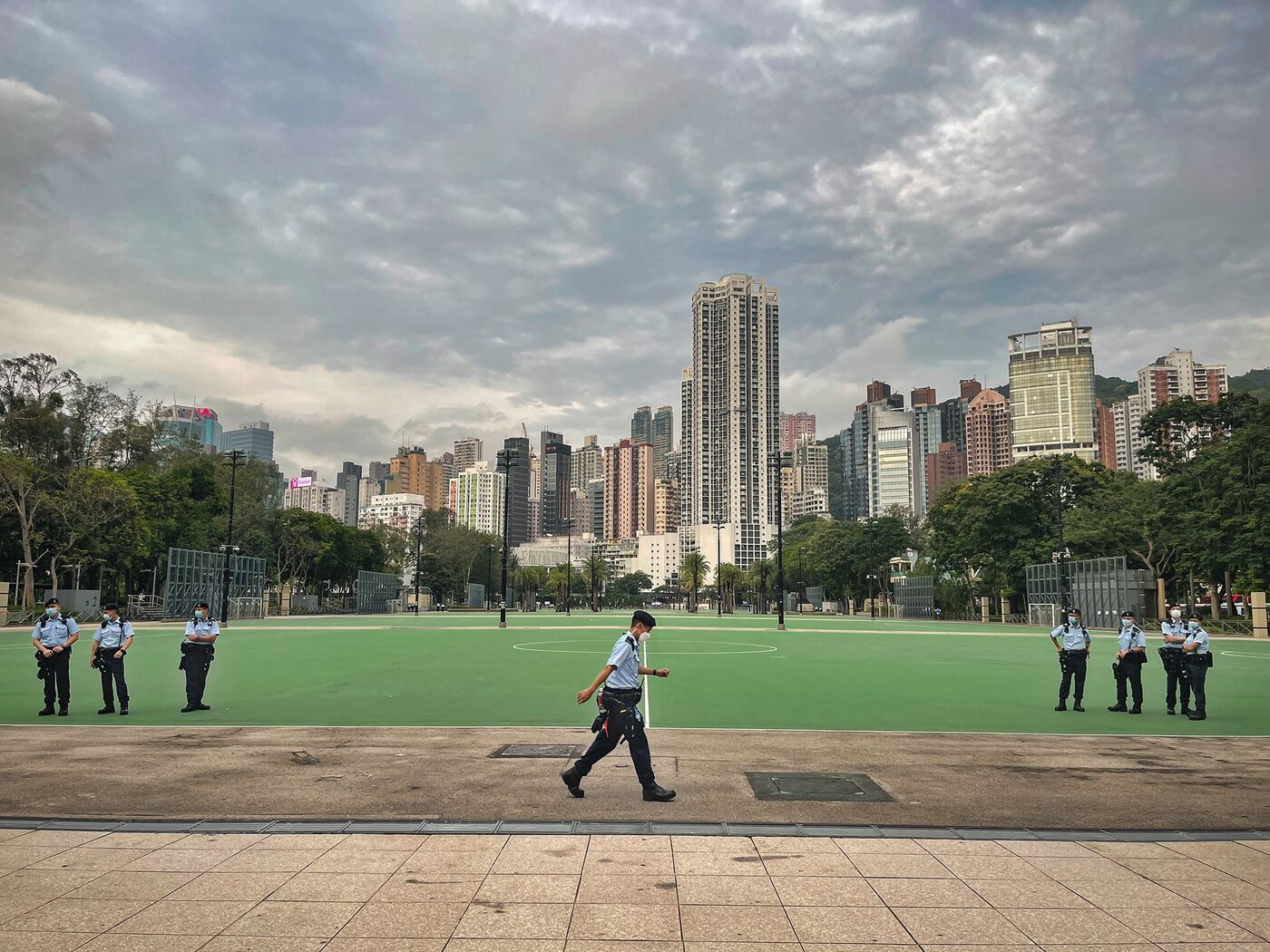 The same football pitches, sealed and empty on the 2021 anniversary, ringed by police. Photo: Studio Incendo, CC BY 4.0, via Wikimedia Commons.

From 2022 the erasure became deliberate. The football pitches where the candles once burned were handed each June to a pro-Beijing "Hometown Market" carnival, filling the site with food stalls and patriotic displays on the anniversary. Heavy police patrols swept Causeway Bay; officers stopped, searched and detained people merely for mourning — carrying an electric candle, holding flowers, wearing a Goddess of Democracy T-shirt, or displaying the number 8964. Performance artists were escorted away; the owner of a car with a "US 8964" plate shipped it abroad after harassment.
Year by year, the anniversary became something to be policed rather than kept:
- 2022 — the first year the site itself was sealed: the Leisure & Cultural Services Department banned the gathering and closed Victoria Park. An 80-year-old man was arrested that day, and AFP saw at least six people taken away (AFP/Malay Mail).
- 2023 — police detained 23 people aged 20–74 near the park, among them a woman holding flowers and an elderly man standing alone with a candle (Al Jazeera).
- 2024 — the carnival returned for a second year; police arrested four around Causeway Bay, one under the new Safeguarding National Security Ordinance for "seditious intention" (AFP/Malay Mail · HKFP).
- 2025 — police arrested two and took away ten more, aged 15–69, including performance artist Chan Mei-tung, and deployed an armoured vehicle in Causeway Bay (HKFP).
- 2026 — the food carnival occupied the park for a fourth year; ten weeks later, on 21 August, the Alliance's leaders were convicted of inciting subversion (HKFP · Al Jazeera).
Yet the commemoration did not die — it scattered. As Victoria Park fell silent, June 4th vigils multiplied across the diaspora: in 2025, more than 30 events in 20 cities — from Taipei and London to Vancouver and Washington — kept the candles lit beyond Beijing's reach. And from behind bars, Chow Hang-tung marked each anniversary with a hunger strike.
The vigil in photographs
A record of the vigil across its years, in freely-licensed photographs preserved in this archive.
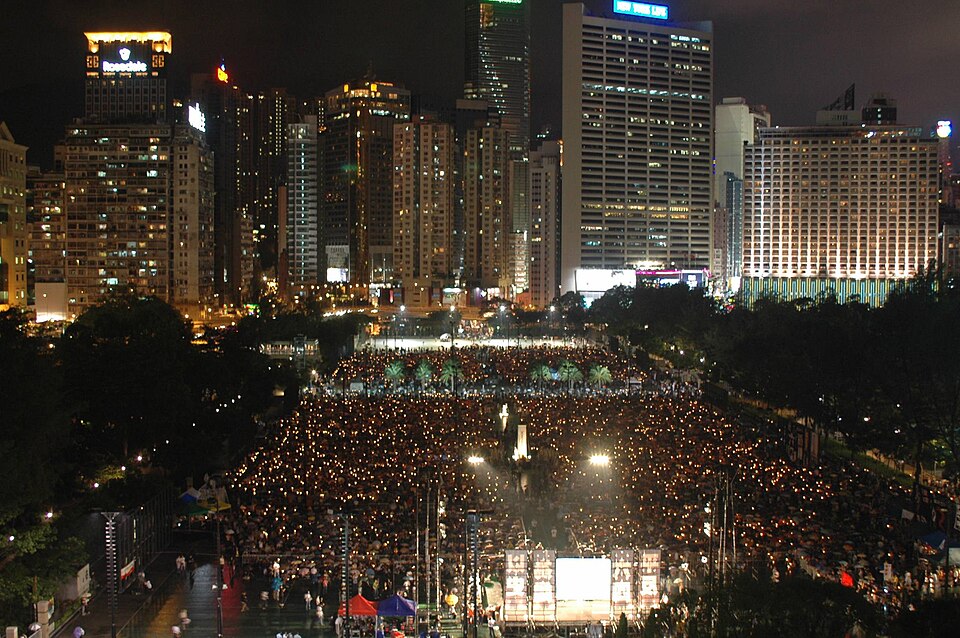 2005 (16th) — Photo: laihiu / LAI Ryanne, CC BY 2.0, via Wikimedia Commons.

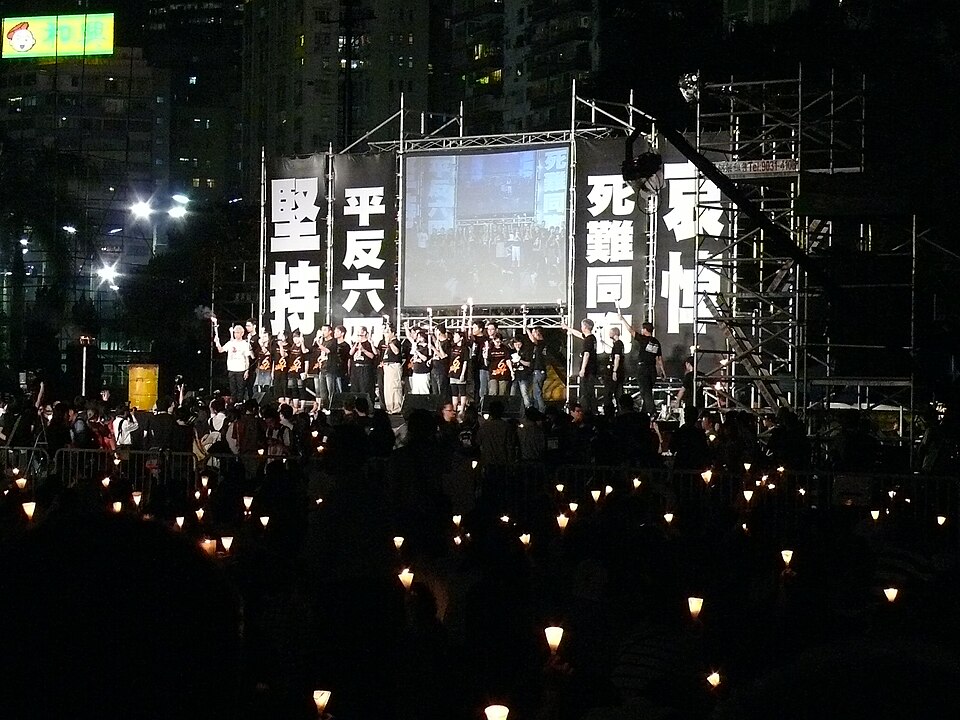 2008 (19th) — Photo: Spacecry, CC BY-SA 3.0, via Wikimedia Commons.

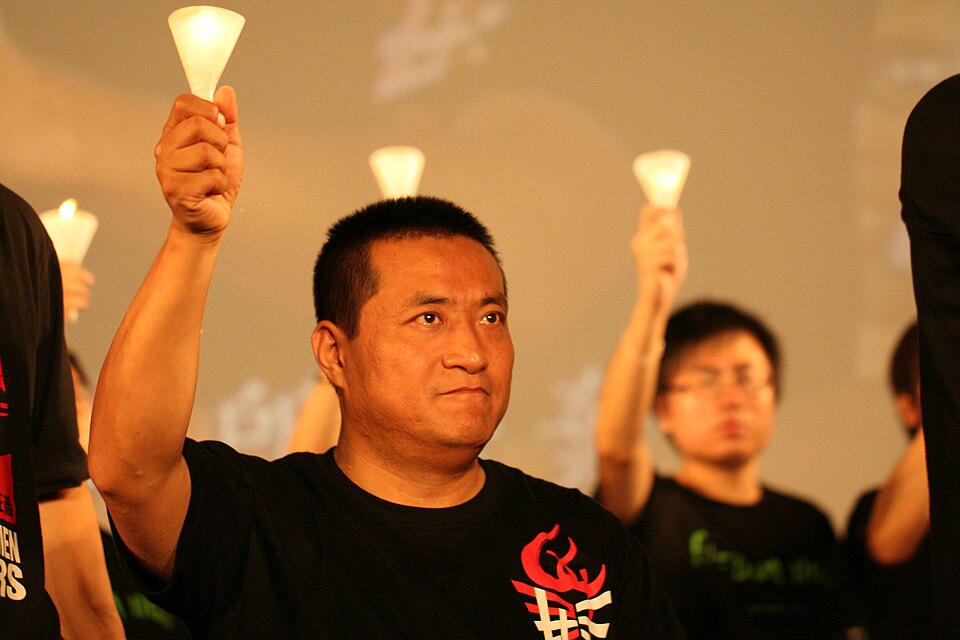 2012 (23rd) — Photo: Voice of America, public domain, via Wikimedia Commons.

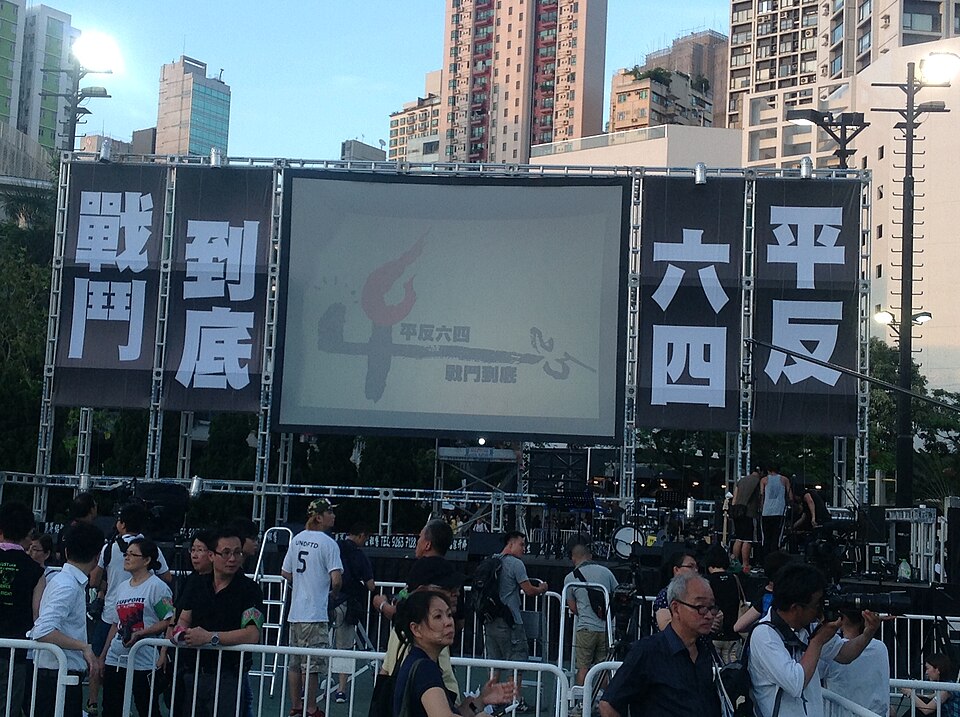 2014 (25th) — Photo: Voice of America, public domain, via Wikimedia Commons.
.jpg)
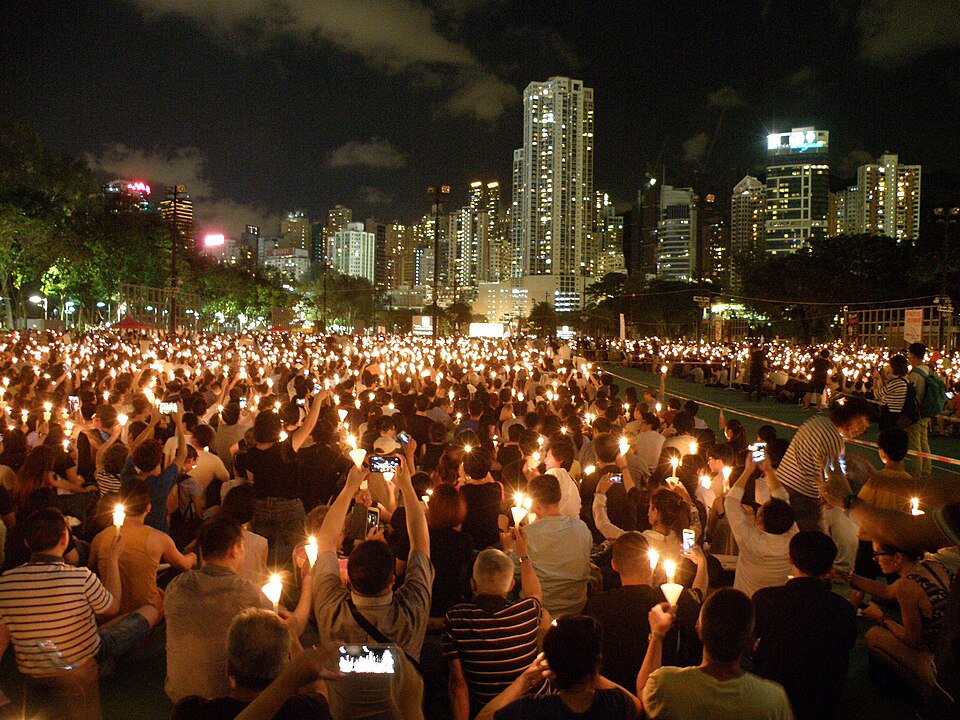 2015 (26th) — Photo: Exploringlife, CC BY-SA 4.0, via Wikimedia Commons.
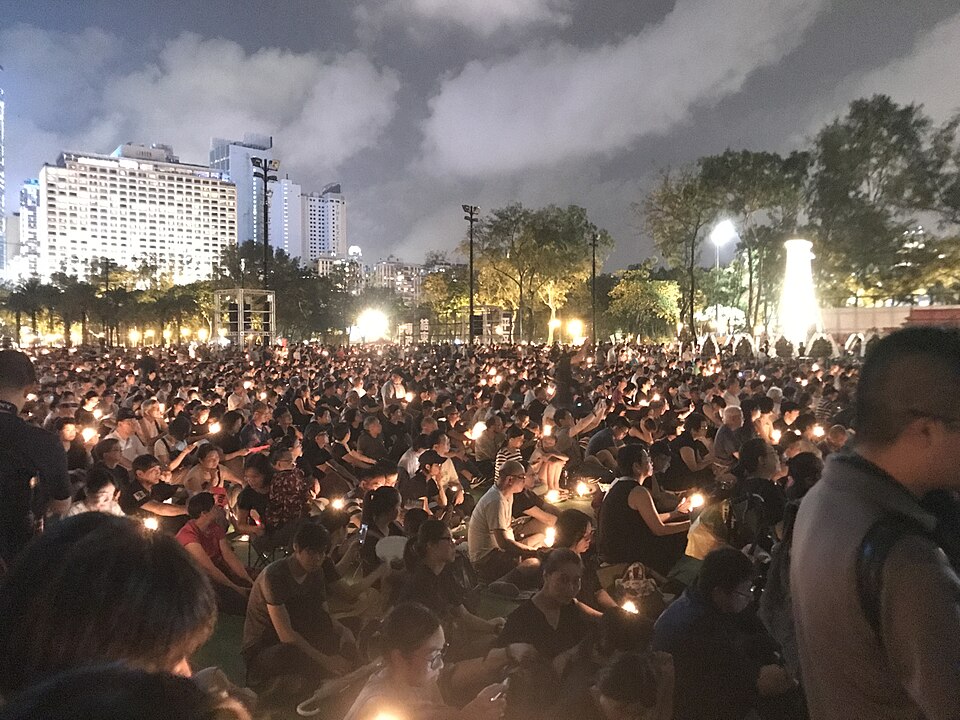 2019 (30th) — the last vigil held in the park. Photo: だ*ぜ, CC BY-SA 4.0, via Wikimedia Commons.

More freely-licensed vigil photographs are preserved in this archive, each credited to its photographer on Wikimedia Commons: 2007 (Simon Lo, CC BY-SA 2.5), 2009 (Clarence, CC BY 2.0), 2010 (laihiu, CC BY 2.0), 2011 (Melanie Ko, CC BY 2.0), 2013 (neverbutterfly, CC BY 2.0), and — after the ban — 2020 (people entering despite the ban; だ*ぜ, CC BY-SA 4.0), 2021 (electronic candles in the US Consulate windows; Studio Incendo, CC BY 2.0) and 2023 (US Consulate General, public domain).


.jpg)

The keepers of the flame
The vigil's disappearance is inseparable from the fate of the people who ran it. In 2026 the Hong Kong Alliance and its leaders were convicted and jailed for incitement to subversion — Chow Hang-tung (7 years 3 months), Lee Cheuk-yan (7 years) and founding member Albert Ho (5 years 2 months) — the state treating three decades of peaceful remembrance as a crime against itself. The Alliance's Tiananmen relics were scattered too: its Goddess of Democracy and Pillar of Shame were removed and seized, and its museum survives only online, from overseas (the 8964 Museum).
From prison, Chow Hang-tung has insisted the flame outlasts its keepers. In a message marking the anniversary she wrote: 「燭光再小,也永不會滅,因為我們有彼此」 — "However small the candlelight, it will never go out, because we have each other" (as reported by 加拿大國際廣播電台 RCI 中文《當維園燭光晚會不再》). The diaspora has taken up the task: in cities such as Toronto, veterans of the 1989 movement and younger émigrés — some of whom attended the Victoria Park vigil only once before leaving Hong Kong — now hold their own June 4th commemorations, passing the memory on.
Help preserve the vigil — a call for submissions
The physical vigil is gone, and inside Hong Kong even remembering it now carries risk. That makes the record more precious. We are gathering materials to preserve the memory of the Victoria Park vigil and its diaspora successors, and we invite you to contribute:
- Photographs and video of any June 4th vigil — Victoria Park or overseas, any year. Wide crowd shots, candles, banners, stage programmes, the sea of lights.
- Personal memories and oral histories — your first vigil, why you went, what it meant, what changed.
- Ephemera — programmes, leaflets, candle holders, badges, banners, songbooks, tickets, photographs of the annual booths.
- Diaspora records — footage, posters and accounts from vigils held abroad since 2020.
If you have material to share, or can help preserve it, please see Participation and How to archive — and take care to protect your identity when you do (Signal, Tor, anonymised files). Even a single photograph helps keep the candlelight from going dark.
Sources
- Wikipedia: Memorials for the 1989 Tiananmen Square protests and massacre
- CNN: Organizers — 150,000 at Tiananmen vigil in Hong Kong (2009)
- HKFP: Explainer — Hong Kong's past Tiananmen commemorations and the trial of the vigil leaders (4 June 2026)
- HKFP: In Pictures — police deploy armoured vehicle on Tiananmen anniversary (4 June 2025)
- HKFP: Diaspora attend Tiananmen anniversary vigils overseas amid ban (5 June 2025)
- RFA: No vigils — Victoria Park silent on Tiananmen anniversary (3 June 2026)
香港中文報道 (Chinese-language coverage):
- 加拿大國際廣播電台 RCI 中文:《報道 — 當維園燭光晚會不再》(Donna Chan,2026年9月12日) — 海外港人如何延續六四悼念的口述記錄
- 中文維基百科:《維園六四燭光晚會》 — 歷年集會的人數、主題與籌款簡表(引 BBC中文、RTHK、on.cc、TVB、眾新聞、RFA 等當年報道),本頁的年度數據即據此整理
Backlinks