🖼️ Culture Under Control|文化審查
Related: 🎬 Films & Documentaries | 📕 Book Censorship under the NSL | 📰 Press Freedom under Siege | 🕯️ Tiananmen Vigil
Hong Kong built M+ and the West Kowloon Cultural District to crown itself as Asia's world city of art — a US$3-billion museum of visual culture meant to stand beside Tate Modern and the Pompidou. It opened in November 2021, eighteen months into the National Security Law. Since then the censorship that closed the city's newsrooms and emptied its library shelves has reached its galleries and cinemas too — rarely by public ban, more often by a quiet edit: a work withdrawn before anyone can ask to see it, a title changed to satisfy a censor, a screening cancelled for "technical reasons." This page gathers those cases as they surface, and keeps the institutions' own notices before they can be edited away.
M+ cancels Hou Hsiao-hsien's The Time to Live and the Time to Die (Nov 2026)
Watch: active — this story is developing.
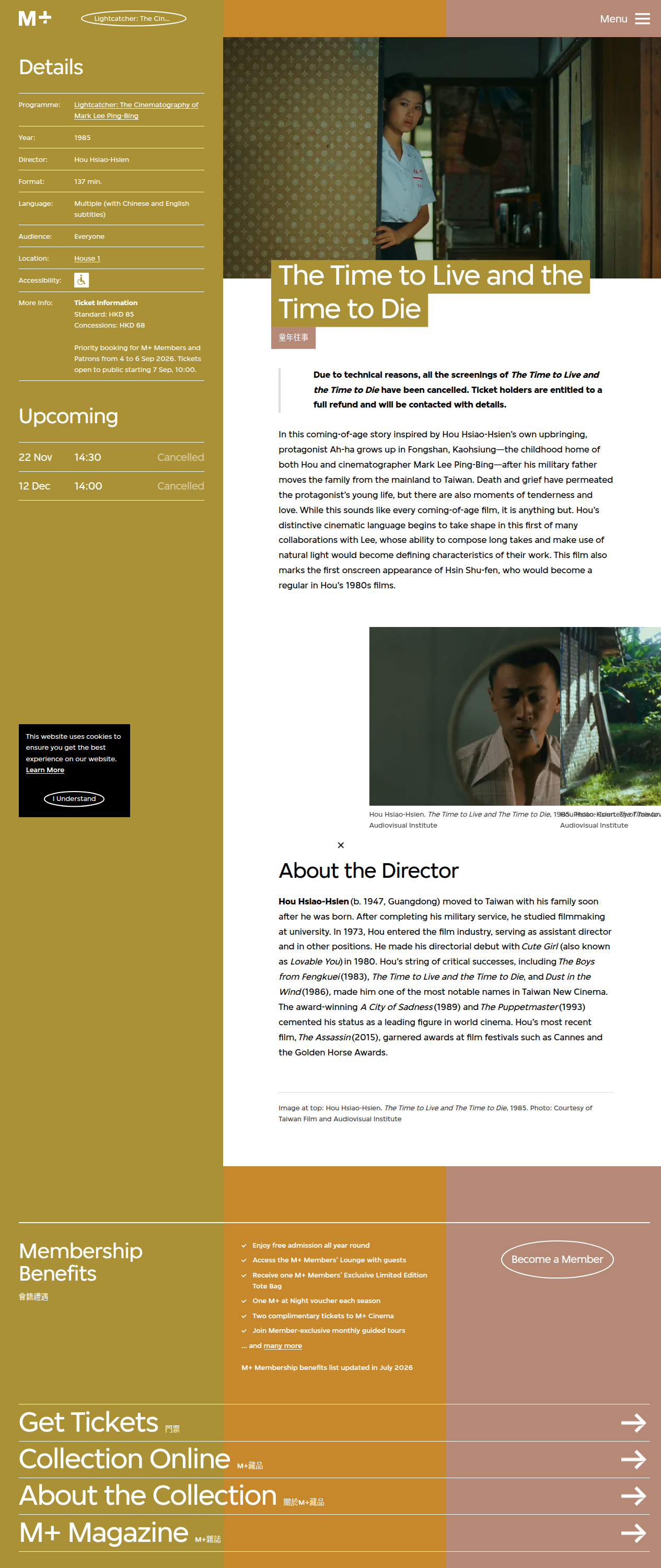
On 13 November 2026, with no advance warning, M+ posted a notice on its website cancelling both scheduled screenings of 《童年往事》 The Time to Live and the Time to Die (1985) — the semi-autobiographical masterpiece by Taiwanese director Hou Hsiao-hsien (侯孝賢), photographed by Mark Lee Ping-bing (李屏賓). The notice, in English only, reads in full:
"Due to technical reasons, all the screenings of The Time to Live and the Time to Die have been cancelled. Ticket holders are entitled to a full refund and will be contacted with details."
The two screenings — 22 Nov 2026, 14:30 and 12 Dec 2026, 14:00 — are both now marked Cancelled on the film's page. No further explanation of the "technical reasons" has been given.
What makes the stated reason hard to credit:
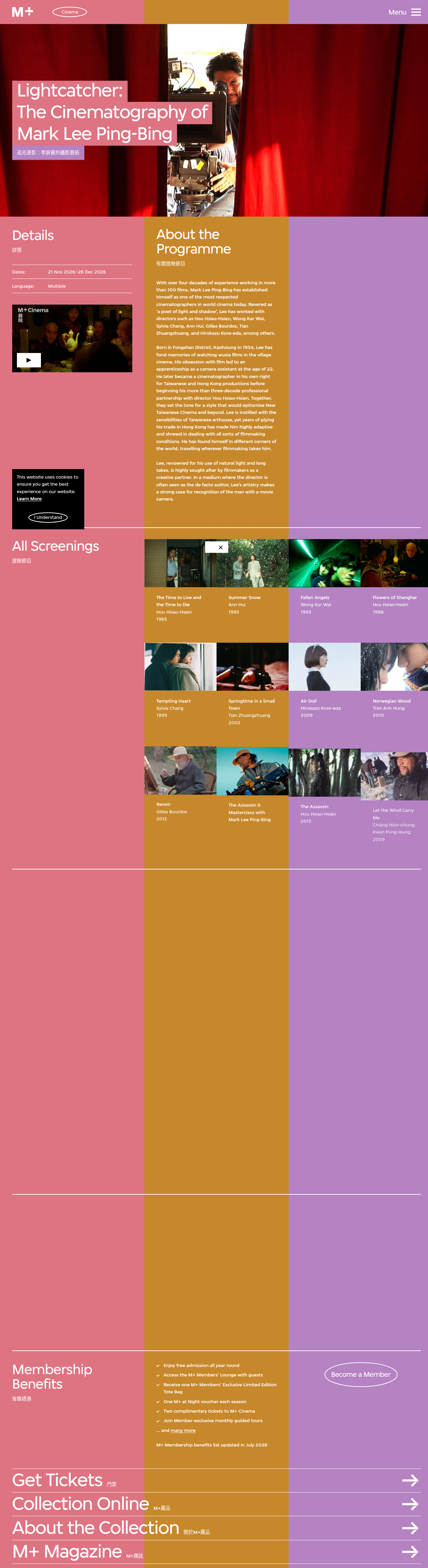
- Only this one film was cut. It was the opening title of "Lightcatcher: The Cinematography of Mark Lee Ping-Bing" (追光逐影:李屏賓的攝影藝術), a ten-film programme running 21 Nov – 26 Dec 2026. The other nine screenings are untouched — including two other Hou Hsiao-hsien films shot by the same cinematographer, The Assassin (刺客聶隱娘) and Flowers of Shanghai (海上花), and his Café Lumière (珈琲時光) in a separate strand. A "technical" fault that strikes one 137-minute print in a retrospective and no other is an unusual kind of fault.
- The Time to Live and the Time to Die is a canonical work of Taiwan New Cinema with no protest or security content — a childhood memoir of a mainland-émigré family in 1950s–60s southern Taiwan. The sensitivity, if any, lies not in the film but in what it stands for: a landmark of Taiwanese cinema, screened as cross-strait cultural exchange narrows.
- At the time of capture the museum's own two pages disagreed: the film page showed both screenings cancelled, while the programme page still listed the 22 Nov screening with no cancelled marker — suggesting a hurried, unannounced change.
Preserved evidence (captured 13 Nov 2026, before the notice can be edited):
- Film page with the cancellation notice — screenshot · HTML cold copy · live page
- Programme page (still showing the screening) — screenshot · HTML cold copy · live page
Open questions being tracked: does M+ give any real explanation of the "technical reasons"? Is the film quietly reinstated or permanently dropped? Do other outlets (HKFP, SCMP, The Witness) confirm it, and is it part of a wider pattern of cancellations? Updates are added here as they surface.
Earlier cases
M+ renames a banned Zhang Yuan film to screen it (2024)
To show the Chinese independent film 《北京雜種》 Beijing Bastards (1993) by Zhang Yuan, M+ screened it under the neutral title "A Film by Zhang Yuan," a change made to obtain a licence from Hong Kong's film censors shortly before the public screening. The retitling — stripping a work of the name its own maker gave it in order to let an audience see it at all — became a widely-cited example of how the museum navigates the censorship regime. (SCMP · Artnet)
M+ opens without Ai Weiwei's Tiananmen photograph (2021)
As M+ prepared to open in 2021, pro-Beijing politicians claimed that Ai Weiwei's photograph "Study of Perspective: Tiananmen Square" — the artist raising his middle finger at the square — could breach the National Security Law. The museum, which had earlier said showing such works would be "no problem," announced it had no plans to display the work, and removed its image from the museum's online collection hub. The institution opened in November 2021 under open accusations of self-censorship. (AP via Smithsonian · Fortune · SCMP: Storm over M+)
Why it matters
A museum is supposed to be where a society keeps what it has decided is worth remembering. When the keeping becomes selective — when a film can be cancelled without a reason, a work withheld before it is ever hung, a title altered to pass a censor — the record itself is quietly rewritten. The cases here are small next to a jailed publisher or a banned song, which is precisely why they are easy to miss and worth preserving: they mark the point at which control stops needing to announce itself.
Preserve the record
If you hold programmes, tickets, booking-page screenshots, email notices to ticket-holders, or press coverage of a cancelled, altered or withdrawn exhibition, screening or performance at M+, the West Kowloon Cultural District, the Hong Kong Palace Museum, LCSD venues or any Hong Kong cultural institution — especially the institution's own notice before it is edited — please help add it: see Participation. A cancellation is easy to erase from a website; a captured notice is not.
Sources
- HK01:M+公布原放映侯孝賢作品《童年往事》 因技術問題取消所有場次 (2026)
- M+: The Time to Live and the Time to Die — programme page (with cancellation notice)
- M+: Lightcatcher — The Cinematography of Mark Lee Ping-Bing
- SCMP: Hong Kong museum has to rename banned Chinese film in order to screen it (2024)
- Smithsonian / AP: M+ museum debuts in Hong Kong amid censorship concerns (2021)
- Fortune: Hong Kong's M+ museum and freedom of expression under the NSL (2021)
- Wikipedia: The Time to Live and the Time to Die
Backlinks